






Compliance Recorder: Why It Matters to Ensure Compliance in Call Recording Practices
Executive Summary
Compliance recorder has evolved from a simple operational tool into a strategic requirement for many organizations. Initially used mainly for convenience purposes such as coaching, quality monitoring, and dispute resolution, it was often limited by on-premises storage constraints, allowing companies to record only a portion of their calls.
With the rise of cloud technology and scalable SaaS models, these limitations have disappeared. Today, companies can record and store virtually all customer interactions across unified communications and contact center software environments, making call recording software for business widely available and increasingly commoditized.
However, recording calls at scale also means storing large volumes of sensitive data, including personal, financial, medical, and legal information. This has made compliance the primary driver behind modern business call recording, as companies must meet strict requirements under regulations such as GDPR, MiFID II, Dodd-Frank, and PCI DSS. In this context, a specialized compliance recorder becomes essential, ensuring secure storage, retention policies, and audit-ready traceability for compliant call recording.
At the same time, storing conversations is no longer enough. Organizations must also extract value from vast call archives, where conversation analytics software and sentiment analysis software help identify risks, detect trends, and improve performance at scale.
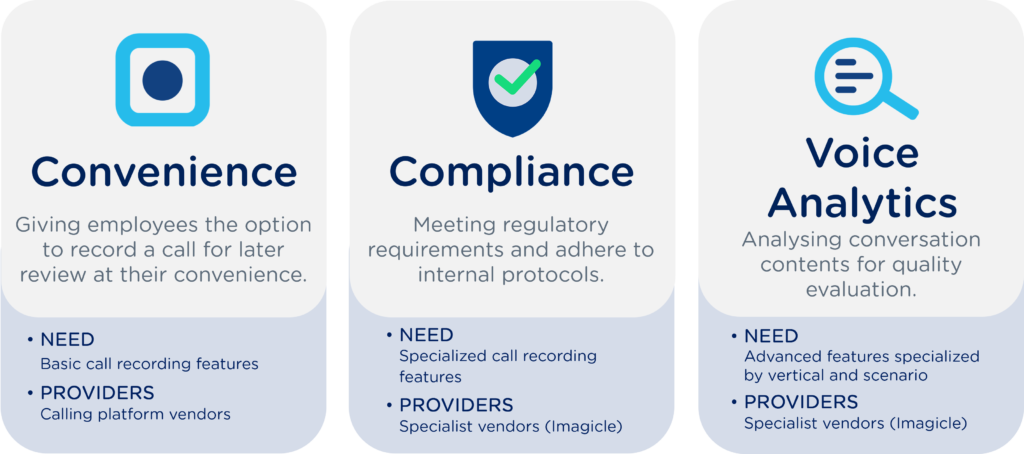
In this whitepaper, we explore the evolution from convenience recording to compliance recording, what key regulations require, and how AI-driven voice analytics software is turning recorded calls into actionable business intelligence.
Table of Contents
Compliance Recorder: what do companies need to be aware of?
On the one hand, companies need to protect the recorded conversations in and outside the contact center software as they include sensitive data. On the other hand, they’re required to record calls and make them easily accessible to comply with regulations such as GDPR, PCI-DSS, HIPAA, and more.
According to Wise Guy Reports, the global call recording solutions market is projected to grow from approximately USD 4.22 billion in 2025 to around USD 10 billion by 2035, with a CAGR of about 9.1% between 2025 and 2035. Innovations in AI and compliance are driving this expansion.
So what regulations should companies be aware of?
What’s the cost of non-compliance?
When can a call recording be defined compliant?
To answer this question, let’s start with the main international regulations your compliance recorder needs to abide by.
GDPR
The General Data Protection Regulation (GDPR) was enacted on 25th May 2018 and it is the main EU regulatory framework designed to protect and strengthen the privacy and security of personal data belonging to EU citizens. It applies not only to organizations operating within the European Union, but also to any company worldwide that collects, processes, or stores EU citizens’ personal information. GDPR requires:
- Profiled and secure access to data
- Traceability of personal information’s access
- Flexible retention policy
- Data at rest encryption and pseudonymization
- Personal data access, editing, and deletion
HIPAA
The Health Insurance Portability and Accountability Act (HIPAA), enacted on August 21, 1996, is a US regulation designed to protect the confidentiality of Protected Health Information (PHI). It applies to healthcare providers, organizations, and their business associates handling PHI in any form (oral, paper-based, or electronic) and requires strict safeguards to prevent unauthorized access, disclosure, or misuse.
MiFID & FINMA
MiFID II (Markets in Financial Instruments Directive) and FINMA regulations aim to strengthen investor protection by increasing transparency and oversight across financial markets. Introduced in 2009 and 2018, they apply to banks, investment firms, brokers, fund managers, trading venues, and other financial market participants.
A core requirement is the mandatory recording of all communications that may lead to a transaction. Communications must be retained for at least five years (up to seven if required by authorities) and be exportable upon regulatory request.
PCI-DSS
The Payment Card Industry Data Security Standard (PCI-DSS) is a security framework designed to protect cardholder data and prevent payment fraud. Enacted on June 30, 2018, it applies to all organizations that store, process, or transmit payment card information. In a call recording context, PCI-DSS requires that sensitive authentication data (such as CID, CAV2, CVC2, CVV2) must never be stored, meaning recordings must support automatic pause or masking of card details. It also mandates encrypted and tamper-proof storage, multi-level access controls, secure network protocols such as TLS 1.1/1.2, and a complete audit trail.
Dodd-Frank
The Dodd–Frank Act, enacted on July 21, 2010, was introduced to increase transparency and accountability in the U.S. financial system after the 2008 crisis. It impacts financial institutions and other market participants.
From a compliance perspective, it requires that any communication leading to a financial transaction be recorded and securely stored, including mobile and digital channels. A compliance recorder must ensure recordings are time-stamped, retained in a tamper-proof (WORM-aligned) format, easily retrievable for regulators, and preserved for typically up to five years.
These are only some of the key regulations provided as examples, but they are by no means exhaustive. Many other regional and industry-specific frameworks (such as FINRA, FCA regulations, SEC rules, CCPA, and various national data protection laws) may also impose strict communication recording and data governance requirements depending on the sector and geography.
5 features to ensure compliant call recording
All the different regulations we’re taking into consideration have some requirements in common, including traceability of data, flexible retention, easy accessibility to the right people, secure storage, and encryption. But how do these requirements translate into features your compliance recorder must have?
1. Role-based access
Role-Based Access Control (RBAC) assigns access rights based on user roles, ensuring they access only the necessary information. In a compliance recorder solution, for instance, a customer service representative might access specific call logs for dispute resolution, while a compliance officer oversees broader regulatory adherence. RBAC is vital for meeting regulations like GDPR and HIPAA.
2. Legal Hold
Legal Hold ensures that specific recordings are preserved during legal disputes until resolution. It involves suspending normal retention policies to protect relevant data, such as a customer complaint or contractual disagreement, from deletion. It is essential for compliance with laws like Dodd-Frank, as it ensures that necessary records are maintained for legal scrutiny, thereby minimizing risks of penalties and enhancing an organization’s legal standing.
3. Configurable Retention Policy
As opposed to Legal Hold, configurable retention allows organizations to set specific retention periods for different types of recordings, such as customer interactions or training sessions, based on their intended purpose. By implementing such policies, businesses can automatically delete obsolete data, thereby minimizing storage costs and reducing the risk of non-compliance with regulations like GDPR.
4. Audit trail
Audit trails in compliance recorder solutions are essential for ensuring transparency and accountability by meticulously tracking and timestamping all user interactions with recordings. This includes every attempt to access, play, download, or delete recordings, providing a comprehensive log of activities. For example, an audit trail can reveal who accessed a confidential call and when, serving as a deterrent against unauthorized actions. These logs are crucial for compliance with regulations such as Dodd-Frank, FINMA & MiFID II.
5. Tampering detection
Tampering detection ensures the integrity of stored data. This involves applying proprietary digital signatures, which serve as a verifiable mark of authenticity. For example, any change to a recording would invalidate its digital signature, alerting administrators to potential tampering.
If you want to discuss with features with an expert, book a call with Imagicle.
Related Content
- Teams Call Recording in 2026 – A Guide By Imagicle
- Teams Voice Call Recording: 4 Things to Do Before Rolling Out The Solution
- Is Microsoft Teams HIPAA Compliant? Meeting Healthcare Standards with Call Recording
What happens if you don’t implement a compliance recorder?
Legally, it exposes the organization to significant fines and penalties. Non-compliance can lead to costly legal actions, draining financial resources and affecting the company’s bottom line. Furthermore, the reputational damage from failing to adhere to these standards can erode customer trust, as clients and stakeholders expect their sensitive information to be handled with the utmost care. The loss of trust can result in decreased customer retention and difficulty in attracting new business. Hence, adhering to relevant compliance standards is not just a legal obligation but a critical component of maintaining a company’s integrity and operational success.
How Imagicle Call Recording ensures compliance
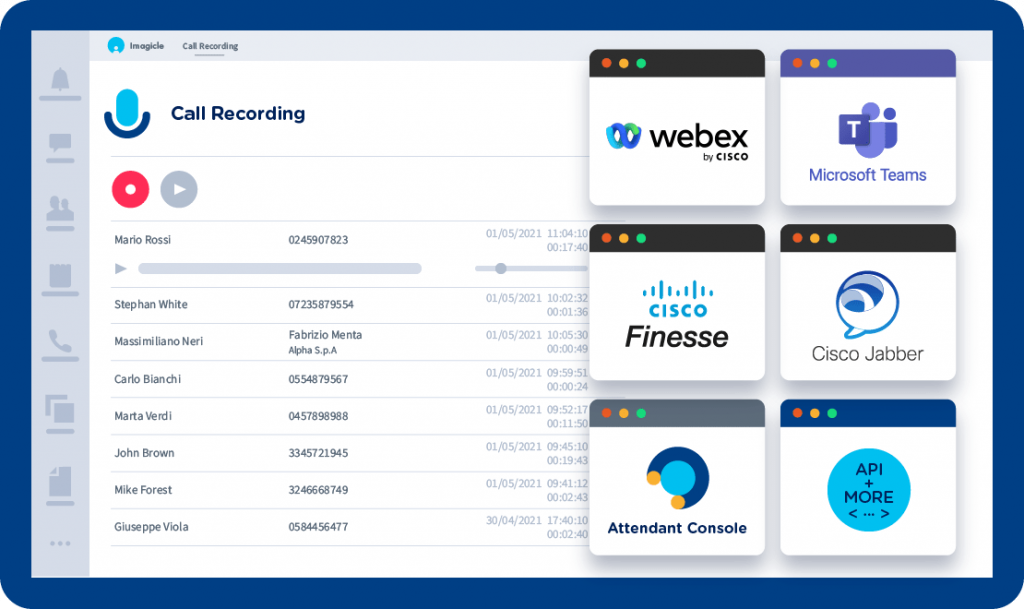
- Role Based Access: record-only users have no access to conversations, standard users only access their own conversations, group supervisors access the recordings of all groups, users with complete management access all conversations and amend global settings.
- Legal Hold: Imagicle Compliance Recorder allows to tag specific recordings for longer retention.
- Configurable retention policy: Imagicle Compliance Recording allows to store recordings up to an unlimited amount of time, with full flexibility on the period you need to retain conversations for depending on the use and relevance of the recording.
- Audit Trail: administrators access to Audit Trail to track, play, download and delete users’ activities on each recording. For each recording, properties such as user and phone, tenant, number, recording date & time stamp, duration, unique recording ID are saved into SQL Server’s index table.
- Tampering detection: both voice and screen recordings are AES encrypted, with digital signage to avoid tampering
Compliance Recorder features in our roadmap
As part of our ongoing innovation strategy, several advanced features are coming soon to further strengthen our compliance recorder capabilities and help organizations improve compliance and data protection. These upcoming enhancements include:
- Manual Agent Scoring – enabling supervisors to manually evaluate and score agent interactions for quality monitoring and coaching.
- PII Redaction – automatically detecting and redacting sensitive information in call recordings to support compliance and privacy.
- Call Summarization and Categorization – AI-generated summaries and automatic call categorization to speed up reviews and improve insights.
- Automated Agent Scoring – AI-driven performance evaluation to deliver consistent and scalable quality scoring.
- Topic modelling – Automatically identify and group recurring topics across customer interactions.
Stay tuned and discover more on our the Imagicle roadmap.
It’s also a matter of user experience
Choosing Imagicle Call Recording is not just about adding compliance. It’s also about boosting the user experience
directly into the platform users and supervisors use everyday.
- It allows to trigger, pause/resume, review, listen, download, delete recordings from the web portal or directly on the Webex, Webex Contact Center or MS Teams app through the exclusive gadget with Search&Play.
- Imagicle adds advanced features for better recording management, including advanced filters per specific users and groups, date, call direction, duration, size, and more.
- Call Recording perfectly integrates with all Cisco calling and contact center platforms, as well as Microsoft Teams,
allowing customers to migrate to the cloud at their own pace with a unified & centralized recording database. - To add the cherry on top, Imagicle Call Recording is also complete with Screen Recording, designed to capture agents’ computer desktop activities during calls and get the complete picture of customer interactions. Available only for Cisco platforms.
How Imagicle completes the picture with AI Speech Analytics
We’ve gone into how convenience and compliance reasons make it paramount to record and store basically all company calls. And since one big use case for call recording is quality monitoring, you can have a huge amount of words spoken in your memory storage, but a very short time to listen to them all.
That’s why, today, AI voice analytics is no longer a “nice-to-have” feature sitting next to call recording: it is becoming a must-have contact center AI solutions. As companies are now recording close to 100% of business communications for compliance and operational reasons, the volume of stored conversations has grown beyond what humans can realistically review.
Without AI speech analytics, most recordings remain unused, turning into a passive archive rather than a strategic asset.
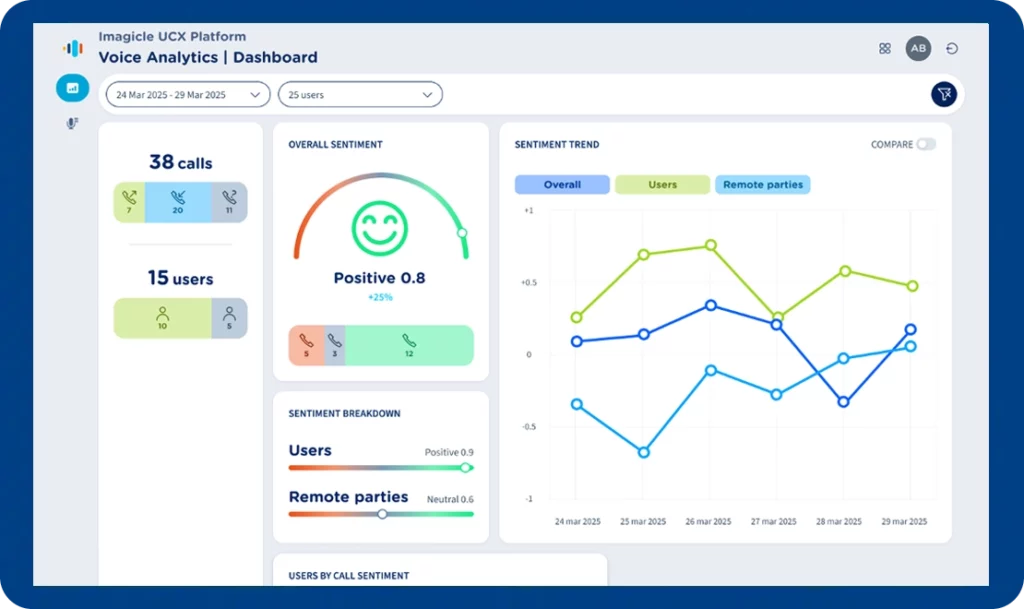
This is why more and more organizations see voice analytics software as inherently intertwined with their compliance recorder.
Beyond saving time and enabling faster quality monitoring, Imagicle AI Voice Analytics delivers a wide range of strategic advantages. By automatically analyzing every recorded interaction, it helps organizations detect recurring customer pain points, measure agent performance objectively, and uncover hidden operational inefficiencies that would otherwise remain buried in thousands of hours of calls.
AI-driven speech analytics also strengthens compliance by identifying risky behaviors in real time, flagging missing mandatory statements, and spotting potential data exposure or policy violations. With advanced keyword detection and sentiment-based alerts, supervisors can proactively intervene before issues escalate into complaints, disputes, or regulatory incidents.
Another key benefit is the ability to generate consistent insights at scale. Instead of relying on random call sampling, companies can analyze 100% of conversations, creating a more accurate view of customer experience trends, agent behavior, and business performance. This transforms call recordings from passive archives into actionable intelligence, enabling continuous improvement across customer care, sales, and support operations.
Finally, by combining transcription, tagging, trend detection, and sentiment analysis software, AI makes conversations searchable and measurable, turning voice interactions into structured data that can be used to optimize processes, reduce churn, and improve customer satisfaction.
Empower your customer service with AI
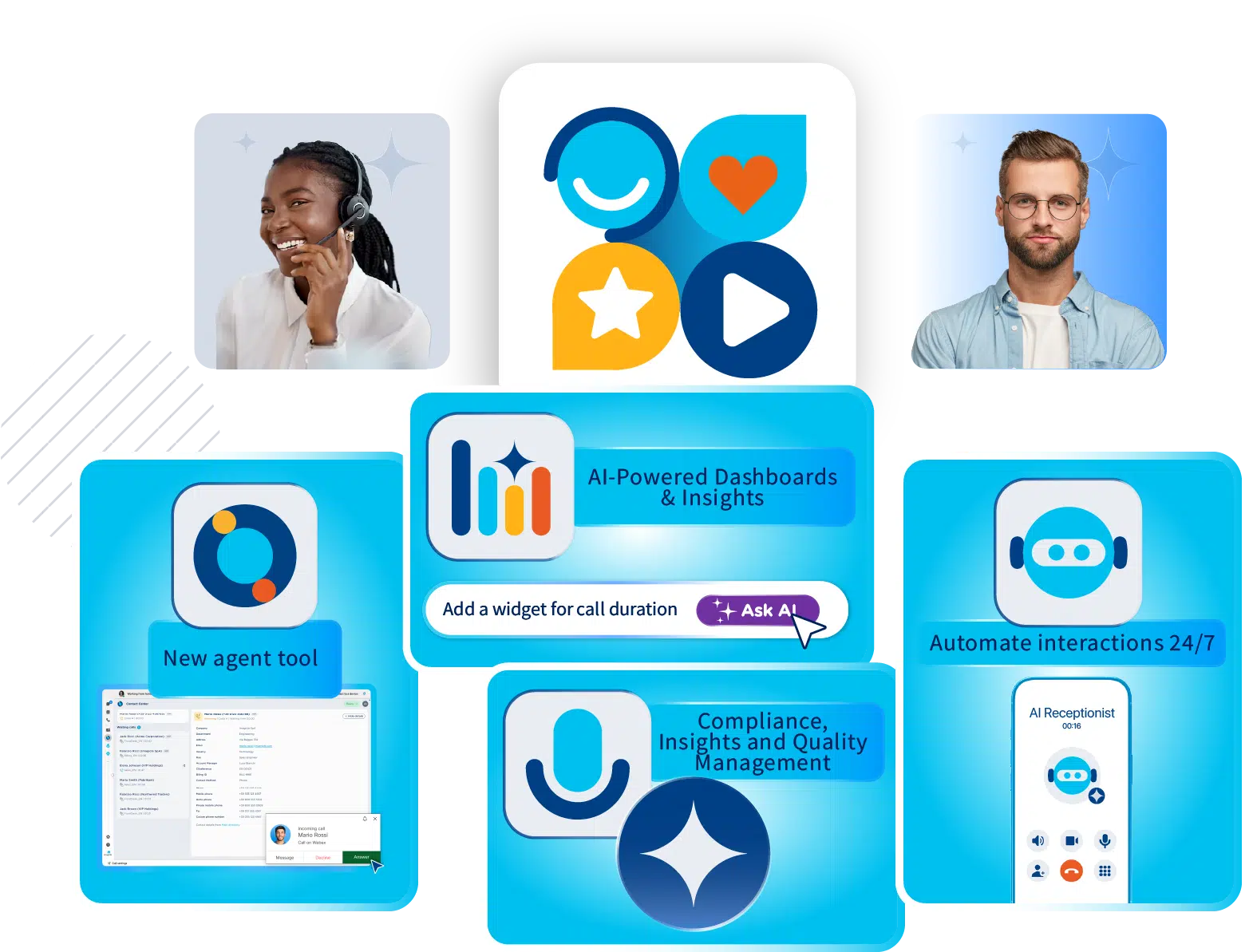
Imagicle AI Voice Analytics is just a little piece of how Imagicle can help you empower your customer service with AI. Join our upcoming webinar AI-Powered Voice Interactions for seamless Customer Service to know more.
FAQs & takeaways
- Why do call recordings need to comply with regulations? Because they store personal,possibly sensitive data and because they can be used as legally binding proof of action.
- What regulations should companies be aware of? GDPR, HIPAA, PCI-DSS, Dodd-Frank, FINMA, MiFID II are the main ones.
- What features create compliant call recording? Role-based access, Legal Hold, configurable retention policy, data security, audit trail, tampering detection.
- What happens if my company’s recordings are not compliant? You can face costly legal actions and fines while
your brand reputation and revenues will suffer as stakeholders won’t see you as trustworthy. - How can Imagicle help me stay compliant? By offering you all the above mentioned compliance features, completed with a unified user experience into your calling platform and the added value of an AI speech voice analytics tools for transcriptions and sentiment analysis.
- Why do I need AI speech analytics? Because it helps you analyze all your customer service interactions at a glance without listening to countless conversations.
About Imagicle
Imagicle is a Zucchetti Group company founded in 2010 with 130+ people across 7 offices in Italy, France, the United States, and the Middle East. We build simple, secure AI, UC, and CX apps you can deploy on-prem, cloud, or hybrid with a seamless experience at any migration stage that elevates both team and customer journeys. We deliver AI-powered UC and CX apps, Omnichannel Contact Center & Receptionist with Virtual Agents, Compliance & Quality Recording, and Advanced Analytics, delivering faster, smarter, and easier communication and collaboration across cloud, hybrid, and on-prem environments for Cisco/Webex and Microsoft Teams.
You might also be interested in…
-
Products Blog
5 Questions Your Communication Data Should Answer Instantly.
5 Questions Your Communication Data Should Answer Instantly.Discover the five questions your contact center data can already answer, and how to get answers the same day instead of days later. -
Products Blog
Communications Analytics in 2026: Why Reports Alone Aren’t Enough
Communications Analytics in 2026: Why Reports Alone Aren’t EnoughDiscover why traditional call reporting no longer keeps up with business decisions, and how the new Imagicle Advanced AI Analytics turns communication data into real-time insight. -
Security Blog
Contact Center Compliance: The 2026 Guide
Contact Center Compliance: The 2026 GuideLearn how to ensure contact center compliance with call recording, speech analytics, and AI tools. Reduce risk and improve customer experience.