








 Fiamma Romano
Traditional contact center metrics still play an important role. KPIs like Average Handle Time (AHT), First Call Resolution (FCR), Service Level, and CSAT help teams measure operational efficiency and service quality.
The problem is that they only describe outcomes. They rarely explain what actually happened during customer interactions or why certain trends are emerging.
A contact center software may maintain acceptable handling times while customer frustration quietly increases. QA teams may review only a small sample of calls and miss recurring issues entirely. CSAT surveys often arrive too late to prevent churn or identify operational problems early enough.
This is why many organizations are moving toward AI-powered contact center analytics. Instead of relying only on static reports, modern platforms analyze conversations directly, helping supervisors understand customer sentiment, detect risks in real time, and identify patterns across thousands of interactions.
Here are the contact center metrics that matter most today and why they are becoming essential for modern customer service teams.
Contact Center Metrics That Improve Your Customer Experience
1. Contact Center Sentiment Analysis
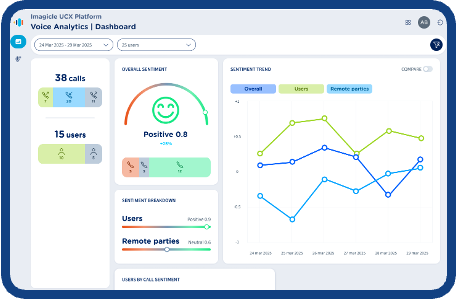
In inbound contact center software, one of the biggest limitations of traditional contact center metrics is that they do not capture emotions. A call can be resolved quickly and still leave the customer frustrated. Similarly, a conversation may take longer than average but end with a highly satisfied customer.
Sentiment analysis (the backbone of contact center speech analytics, based on contact center call recording software) helps bridge this gap by evaluating the emotional tone of conversations. Using AI and natural language processing, AI contact centers can identify whether interactions are positive, neutral, or negative and track how sentiment evolves throughout the conversation.
This becomes particularly valuable when analyzing contact center customer experience at scale. Supervisors no longer need to rely exclusively on surveys or manual call reviews to understand how customers feel. Instead, they can identify patterns across every interaction.
For example, a sudden increase in negative sentiment around billing conversations may reveal a problem long before traditional reports detect it. Support teams can investigate the issue early, adjust internal processes, or escalate feedback to other departments before customer dissatisfaction spreads further.
Sentiment analysis is also useful for agent coaching. It helps identify conversations where customers became frustrated, allowing supervisors to focus reviews on interactions that require attention instead of relying on random QA sampling.
2. Real Time Call Monitoring
Many contact centers still rely on historical contact center metrics to understand performance issues. The problem is that by the time reports are reviewed, service levels may already have dropped, queues may be overloaded, and contact center customer experience may already be affected.
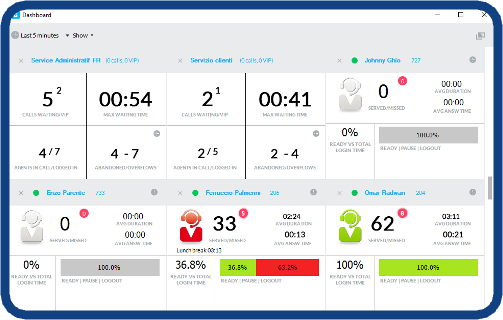
Real-time monitoring helps supervisors understand what is happening across the contact center software while operations are still in progress.
Instead of focusing only on individual calls, modern monitoring solutions provide visibility into queue conditions, agent availability, waiting times, abandoned calls, and workload distribution in real time. This allows teams to react immediately when traffic spikes or service levels start declining.
Queue management becomes especially important during peak hours or unexpected increases in contact volume. Supervisors need to quickly identify overloaded queues, redistribute agents, prioritize critical interactions, or adjust staffing before waiting times become unmanageable.
Wallboards play a key role in this process by making operational metrics visible across the entire contact center. Live dashboards displayed in shared environments help agents and supervisors monitor queue performance continuously, track SLA targets, and maintain awareness of current workload conditions.
Modern contact center analytics platforms combine real-time monitoring with intelligent alerting, allowing supervisors to detect service bottlenecks early and maintain better control over customer experience before issues escalate.
3. Call Summarization
After-call work remains one of the most time-consuming activities for contact center agents. Writing summaries, updating CRM records, documenting next steps, and categorizing interactions manually all reduce the amount of time agents can dedicate to actual customer conversations.
The process is also inconsistent. Some summaries contain useful details, while others are incomplete or difficult for other teams to interpret later.
AI-powered call summarization addresses this problem by automatically generating concise and structured conversation recaps after each interaction. These summaries can include the reason for the call, the actions taken by the agent, unresolved issues, and any required follow-up activity.
The operational impact of these contact center metrics is significant. Agents spend less time on repetitive administrative tasks, supervisors gain more consistent documentation, and CRM systems become easier to maintain accurately.
Automated summaries are particularly useful in environments where conversations are frequently transferred between departments or require multiple follow-ups. Instead of reviewing full recordings or interpreting unclear notes, teams can immediately access a clear summary of what happened during the interaction. This problem could also be solved by automated AI Receptionists or IVR contact centers being the first point of contact – they collect relevant information before transferring the call, providing full context to the agent. And sometimes, they just handle it entirely on their own, lightening the workload for agents.
Reducing after-call work also has a direct impact on productivity. Agents can focus more on the customer conversation itself rather than on the documentation process that follows it.
Related Content
- Contact Center Call Recording Software: Improve Quality and Compliance with Imagicle
- AI Receptionist for Small Business: Why Missing Calls Is a Bigger Problem Than You Think
- Microsoft Teams Call Reporting: Why It Matters
4. Topic Modeling
Most contact centers still rely heavily on manual tagging to classify interactions. The problem is that manual categorization is often inconsistent and too limited to reveal broader trends.
Topic modeling uses AI to automatically identify recurring themes across conversations based on the actual language customers use. Instead of assigning predefined labels manually, the system detects patterns organically across large volumes of interactions.
This helps organizations understand what customers are really contacting support about.
A sudden increase in conversations related to shipping delays, login issues, billing confusion, or cancellation requests may indicate operational problems that are not yet visible through traditional reporting. Topic modeling makes these trends easier to identify early.
The value extends beyond customer service operations. Product teams can use these insights to identify usability issues, marketing teams can better understand customer expectations, and operations leaders can spot inefficiencies affecting contact center customer experience.
In short, customer conversations contain valuable business intelligence that remains largely unused. Topic modeling helps transform that unstructured data into actionable operational insight.
5. Keyword Alarms
Some moments inside a customer conversation require immediate attention. A customer may mention cancelling a subscription, threaten legal action, ask repeatedly for escalation, or reference a competitor during the interaction.
Detecting these moments manually across thousands of conversations is not realistic.
Keyword alarms allow contact centers to monitor conversations automatically and trigger alerts when specific words or phrases are detected. Supervisors can then review the interaction immediately and decide whether intervention is necessary.
These contact center metrics are particularly valuable for retention management and contact center compliance monitoring. If customers frequently mention cancellation requests or express dissatisfaction around a specific issue, support leaders can identify the trend early and respond more quickly.
Keyword-based alerts also improve quality assurance processes. Instead of reviewing a small random sample of calls, QA teams can focus directly on interactions that contain high-risk language or critical customer signals.
The result is more targeted oversight and better operational visibility without increasing manual review workload.
6. Agent Scoring
Traditional QA processes usually evaluate only a small sample of customer interactions, making it difficult to measure agent performance consistently across the entire contact center.
Agent scoring introduces a more structured and scalable approach to quality management.
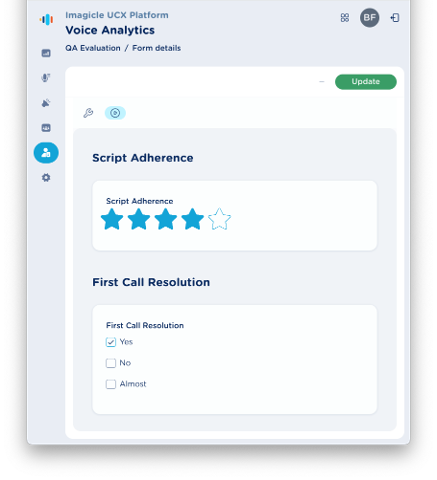
By combining operational KPIs with AI-powered conversation analysis, supervisors can evaluate agents based on criteria such as script adherence, communication quality, first call resolution, empathy, contact center compliance, and customer sentiment. Instead of relying only on generic productivity metrics, teams gain a clearer understanding of how agents actually handle customer interactions.
This type of scoring is especially valuable for identifying coaching opportunities. Supervisors can track performance trends over time, detect recurring weaknesses, and provide more targeted training based on measurable interaction data rather than subjective evaluations.
Agent scoring also improves consistency across QA processes. Standardized evaluation criteria help create clearer expectations for agents while making performance reviews more transparent and actionable.
Most importantly, it connects quality management directly to contact center customer experience. High-performing agents are not simply the fastest agents: they are the ones who resolve issues effectively, follow processes correctly, and create positive customer interactions consistently.
Need Help Getting Started With Contact Center Analytics?
Customer interactions contain valuable operational data, but extracting meaningful insights manually is no longer scalable for modern support teams.
Imagicle helps with contact center AI solutions with quality management that adapt to your business needs.
Supervisors can monitor queues and agent activity live through customizable wallboards and dashboards, tracking contact center metrics such as waiting calls, service levels, abandoned calls, average answer times, and agent availability in real time. This allows teams to identify bottlenecks early, react faster during peak traffic periods, and maintain better control over customer experience across every queue.
Beyond operational monitoring, Imagicle’s AI-powered voice analytics software help organizations understand what is happening inside customer conversations. Features such as contact center speech analytics and sentiment analysis, AI transcriptions, automated call summarization, topic modeling, and keyword alarms transform voice interactions into actionable business insights. Instead of reviewing calls manually, teams can quickly identify recurring issues, detect escalation risks, and uncover trends across thousands of interactions.
Historical AI reporting and customizable dashboards also provide long-term visibility into both queue and agent performance. Supervisors can generate reports automatically, configure alerts for undesired events, and access role-based analytics tailored to administrators, team leaders, or QA managers.
To support continuous improvement, Imagicle also includes agent scoring and quality evaluation tools that help measure script adherence, first call resolution, and overall interaction quality. This enables more targeted coaching, clearer performance tracking, and data-driven training initiatives.
By combining real-time call monitoring, queue management, AI analytics, and quality management in a single platform, Imagicle helps contact centers improve operational efficiency while delivering a better customer experience.
Book a call with an Imagicle expert for a customized demo
Sie könnten auch interessiert sein an...
-
Products Blog
5 Quick Upgrades to Improve Agent Experience Inside Your Collaboration App
5 Quick Upgrades to Improve Agent Experience Inside Your Collaboration AppLearn how to improve contact center agent experience with queue visibility, VIP prioritization, and CRM screen pop inside Webex or Microsoft Teams. -
Products Blog
5 Questions Your Communication Data Should Answer Instantly.
5 Questions Your Communication Data Should Answer Instantly.Discover the five questions your contact center data can already answer, and how to get answers the same day instead of days later. -
Products Blog
Cloud Based Contact Center Software Benefits: Is It Right For Your Business?
Cloud Based Contact Center Software Benefits: Is It Right For Your Business?Discover what a cloud based contact center software is, its benefits vs on-premise systems, and how to know if it’s the right choice for your business growth.